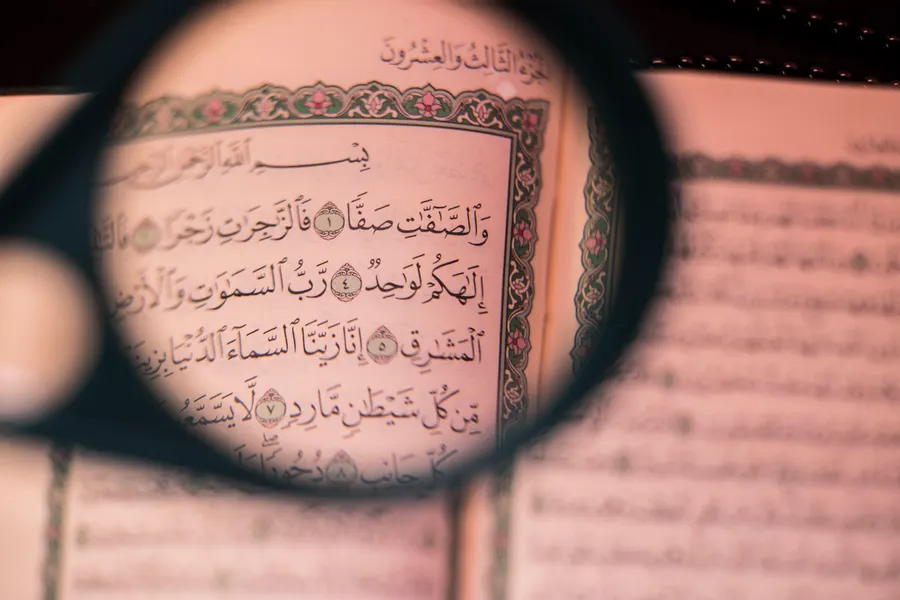
Tajweed rules are the rules for pronouncing every letter of the Quran from its correct place, with its correct qualities and length. This guide explains each group of rules simply, with links to a full post on every rule.
Reading a guide gives you the theory. To apply it, a teacher needs to hear you, which is what our one-to-one Tajweed lessons are for.
What Is Tajweed and What Does the Word Mean?
The tajweed meaning comes from the Arabic root j-w-d, to make something excellent. In recitation, it means giving each letter its right, called haqq, and its due, called mustahaq.
The Quran asks for measured recitation in Surah Al-Muzzammil (73:4). Ibn al-Jazari, the great scholar of recitation, wrote in his poem al-Muqaddimah that holding to Tajweed is a firm necessity for anyone reciting the Quran.
Where Do the Arabic Letters Come From?
Every rule starts with makharij, the points where letters are formed. Scholars group them into five areas.
| Area | Examples |
|---|---|
| The empty space of the mouth and throat (jawf) | The long vowels alif, waw and ya |
| The throat (halq) | Hamza, ha, ayn, haa, ghayn, khaa |
| The tongue (lisan) | Qaf, kaf, jeem, the heavy and light s and t sounds |
| The lips (shafatan) | Ba, meem, waw and fa |
| The nose (khayshum) | The nasal sound of ghunnah |
What Are the Rules of Noon Sakinah and Tanween?
A noon with a sukoon, or tanween at the end of a word, is read in one of four ways, depending on the letter after it.
| Rule | Letters After It | What Happens |
|---|---|---|
| Izhar | The six throat letters | Noon read clearly |
| Idgham | Ya, ra, meem, lam, waw, noon | Noon merges into the next letter |
| Iqlab | Ba | Noon turns into a hidden meem |
| Ikhfa | The remaining 15 letters | Noon is hidden with ghunnah |
Meem sakinah has three similar rules: ikhfa shafawi before ba, idgham shafawi before meem, and izhar shafawi before all other letters. See meem sakinah rules and ikhfa shafawi.
What Are Qalqalah, Ghunnah and Madd?
Qalqalah is a light echo on five letters when they carry a sukoon: qaf, taa, ba, jeem and dal, remembered as qutbu jad. The echo is stronger when you stop on the letter.
Ghunnah is the nasal sound held for two counts, most clearly on a noon or meem with a shaddah.
Madd means stretching a vowel. Natural madd lasts 2 counts, connected and separated madd last 4 or 5 in the common Hafs reading, and necessary madd lasts 6.
Which Letters Are Heavy, and Where Should You Stop?
Seven letters are always heavy: khaa, saad, daad, ghayn, taa, qaf and dhaa. Ra and the lam in the name Allah are heavy or light depending on the vowel before them.
Stopping signs in the Mushaf tell you where to pause. A small meem means you must stop, la means do not stop, and three dots in two places mean stop at one of them, not both. Our post on stopping and starting covers every sign.
Does a Colour-Coded Mushaf Help You Learn Tajweed?
Yes. Many students read from a colour-coded Mushaf, where each rule is printed in its own colour, so you see a ghunnah, a qalqalah or a long madd before you reach it.
Our guide to the colour-coded Tajweed Quran explains how the colours work and how to use them alongside a teacher.
How Should You Practise Tajweed Every Day?
Pick one rule a week. Find it in Juz Amma, read every example aloud, and record yourself. Then listen back while following a colour-coded page to catch any example you missed.
Listening matters as much as reading. Follow one reciter, such as Mahmoud Khalil al-Husary, whose slow recitation makes each rule easy to hear, and copy his lengths and stops.
What Else Do People Ask About Tajweed?
Which Tajweed topics should a beginner learn first?
Start with makharij, the noon and meem sakinah rules, qalqalah, ghunnah, the main kinds of madd and the stopping signs. These cover most of what you meet in every page of the Quran.
How many rules does Tajweed have?
There is no single fixed number. Books group the rules differently, but the main families are the ones in this guide, each with smaller rules inside it.
Is it wrong to recite without Tajweed?
Scholars of recitation teach that clear mistakes which change a word or its meaning must be avoided. Learning step by step with a teacher is how Muslims have always fixed these mistakes.
Can I learn the quran tajweed rules on my own?
You can learn the names and theory from books and charts. Applying them correctly needs someone to hear you, because you cannot easily hear your own mistakes in length and sound.
Want a Teacher to Check Your Tajweed?
Learn these rules of tajweed with an Ijazah-qualified teacher who corrects every letter, live and one-to-one. Your first week is free.