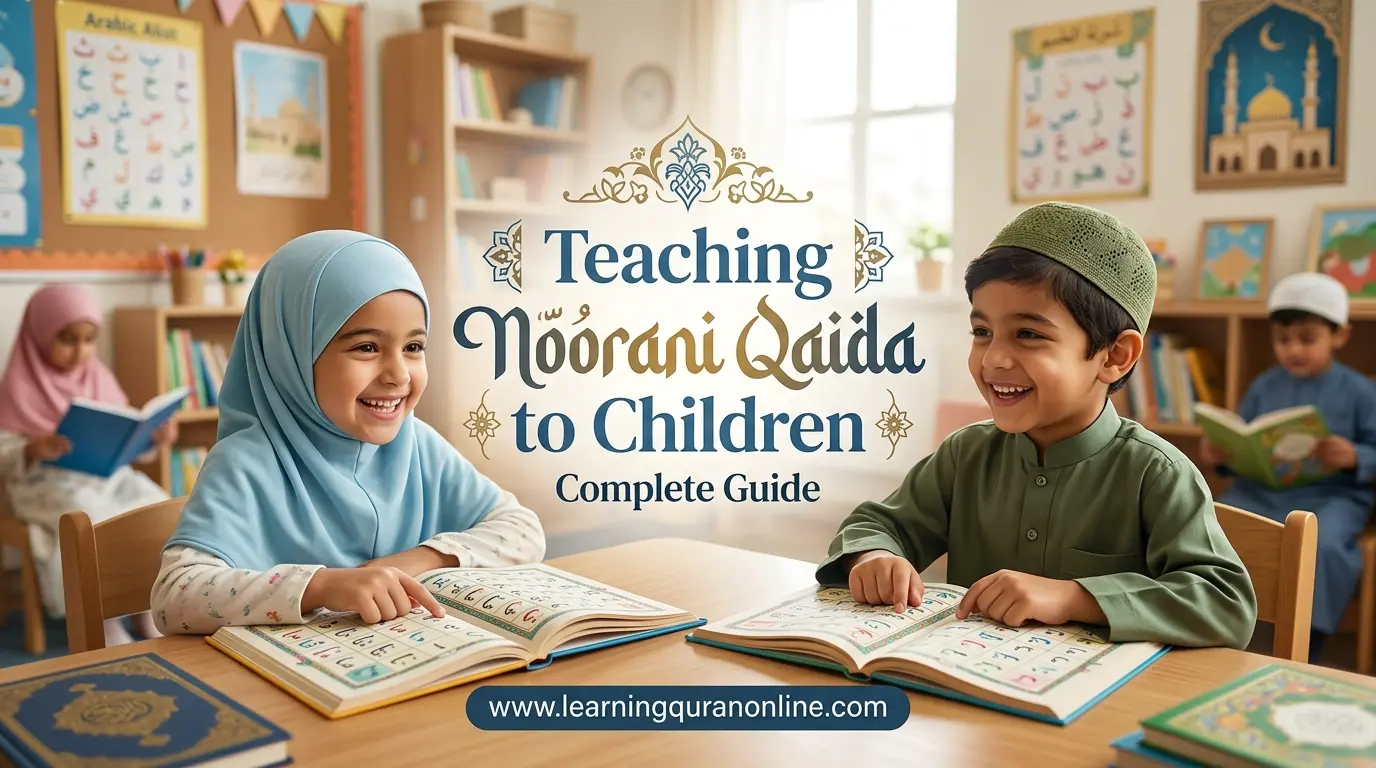
Noorani Qaida is the foundational primer that helps children learn Arabic letters, correct pronunciation, and the basics of tajweed so they can confidently begin reading the Qur’an. Whether you are a parent, an Islamic school teacher, or an online instructor, this complete guide will walk you through age-appropriate methods, lesson plans, teaching techniques, and resources to teach Noorani Qaida to children successfully.
Table of Contents
ToggleWhy Noorani Qaida Matters: Building a Strong Foundation
Learning Noorani Qaida provides essential building blocks: recognition of the Arabic alphabet, vowel signs (harakat), sukun, madd (prolongation), and basic tajweed rules like qalqalah and ikhfa. These early skills are critical for developing proper Quranic recitation. Good Noorani Qaida teaching emphasizes phonetics, makhraj (points of articulation), and rhythmic reading — all of which reduce mistakes later when children read longer surahs.
Who Should Start and When: Age-Appropriate Guidance
Children can begin Noorani Qaida as early as 4–6 years old, depending on their language development and attention span. Some prerequisites that help:
- Interest in stories and songs (good for introducing sounds)
- Ability to sit and focus for short periods (10–20 minutes)
- Familiarity with simple letters via play or flashcards
For older beginners (7+), a faster pace with more formal lessons is possible. Always adapt to the child’s individual learning speed; the goal is mastery, not speed.
Preparing Materials: What You Need
A well-prepared teacher uses a mix of visual, auditory, and tactile resources. Essential materials for teaching Noorani Qaida to kids include:
- Noorani Qaida book (age-appropriate edition) or digital equivalent
- Flashcards of Arabic letters and harakat
- Colored markers and a whiteboard
- Worksheets for tracing letters and combining letters with vowels
- Audio recordings of proper recitation and tajweed
- Apps or interactive games for reinforcement
Teaching Methods: Practical Approaches That Work
Different children learn differently. Use a mix of methods — multisensory, phonics-based, and play-based approaches — to teach Noorani Qaida effectively.
1. Phonics and Sound Drills
Start with clear pronunciation of each Arabic letter and its makhraj. Use short, frequent sound drills and repetition. Emphasize differences between similar sounds (e.g., ص vs. س, ط vs. ت).
2. Visual Recognition
Use colorful flashcards and posters for letter recognition. Show letters in isolation and in combination with vowels. Visual cues help with memorization and letter-sound association.
3. Kinesthetic Learning
Incorporate tracing letters, writing on sand trays, or using magnetic letters. Tracing helps with letter shapes and directionality (right-to-left). Movement-based games enhance retention.
4. Audio and Imitation
Play recordings of native reciters and model correct tajweed. Have children imitate short phrases. Listening and imitation strengthen pronunciation and rhythm.
Sample Lesson Plan: Week-by-Week Structure
A consistent, scaffolded lesson plan ensures steady progress. Here’s a sample 8-week starter plan for beginners:
- Week 1: Introduce 5–7 letters (Alif, Ba, Ta, Sa, Jeem). Focus on sounds, names, and tracing.
- Week 2: Add harakat (fatha, kasra, damma) and practice syllables (ba, bi, bu).
- Week 3: Combine letters with vowels into simple words and short reading drills.
- Week 4: Introduce sukun and tanween basics; practice pronunciation variations.
- Week 5: Teach madd letters (Alif, Waw, Ya) and simple rules for prolongation.
- Week 6: Focus on basic tajweed rules: qalqalah, noon sakin/ tanween rules.
- Week 7: Reading practice with Noorani Qaida pages; introduce short surah reading.
- Week 8: Assessment, review, and reinforcement activities with games and audio.
Fun Activities and Games to Reinforce Learning
Integrate play into every lesson. Children learn best when they’re engaged and enjoying the process. Try these activities:
- Letter hunt: hide flashcards and ask kids to find and recite the sound
- Matching game: match letters with their vowel forms
- Tap-and-say: clap for each haraka in a word to practice rhythm
- Story time: create simple stories using words formed from Noorani Qaida lessons
- Interactive apps: Use child-friendly Noorani Qaida apps for extra practice
Common Challenges and Solutions
Teaching Noorani Qaida comes with recurring challenges. Here are practical solutions:
- Difficulty with similar sounds: Use makhraj diagrams and mirror practice to show mouth positions.
- Short attention span: Keep lessons short (10–20 minutes) and include movement breaks.
- Forgetting harakat: Use color-coding and frequent short quizzes to reinforce memory.
- Fear of mistakes: Encourage a safe learning environment; praise effort and correct gently.
- Lack of motivation: Introduce rewards, stickers, progress charts, and group recitation to motivate.
Assessment and Progress Tracking
Regular assessment helps identify strengths and areas for improvement. Use these techniques:
- Weekly oral checks: ask the child to recite letters, syllables, and short words
- Monthly written assessment: short worksheets on letter-sound matching and tracing
- Recording recitation: listen to audio recordings periodically to assess tajweed progress
- Maintain a progress chart: mark mastery of each Noorani Qaida page or lesson
Resources: Books, Apps, and Online Support
A variety of resources can supplement classroom teaching:
- Noorani Qaida book editions and teacher guides
- Children’s tajweed audio and video tutorials
- Interactive apps for the Arabic alphabet and Noorani Qaida practice
- Printable worksheets and flashcard sets
- Online classes and tutors for one-on-one instruction
When choosing resources, look for clear tajweed demonstration, child-friendly design, and activities that reinforce phonics and reading fluency.
Tips for Parents and Teachers: Best Practices
Small, consistent steps deliver big results. Here are practical tips:
- Start slowly and focus on accuracy before speed.
- Use multi-sensory teaching: see, hear, touch.
- Make sessions regular but short — daily practice is better than long, infrequent lessons.
- Encourage recitation of short surahs to apply Noorani Qaida skills in context.
- Celebrate progress with certificates, stickers, or a simple “well done” to build confidence.
- Model correct recitation and be patient — children learn best from positive reinforcement.
Group Classes vs. One-on-One Tutoring
Both formats have advantages:
- Group classes: Social motivation, peer learning, and cost-effective.
- One-on-one: Personalized pace, focused correction, and tailored lesson plans.
For beginners, a hybrid model — small group lessons with periodic one-on-one check-ins — often works best.
Maintaining Momentum: Keeping Children Engaged
To keep learners motivated:
- Rotate activities to prevent boredom.
- Use rewards linked to skill milestones rather than time spent.
- Include family members in recitation sessions to create a supportive environment.
- Link Noorani Qaida learning to real-life practice — recite during prayer times or family gatherings.
Conclusion
Teaching Noorani Qaida to children is a rewarding journey that lays the groundwork for lifelong Quranic literacy. With the right materials, effective teaching methods, consistent practice, and a supportive environment, children can develop accurate pronunciation, confidence in recitation, and a love for reading the Qur’an. Use multisensory techniques, short, consistent lessons, and engaging activities to make Noorani Qaida learning both effective and enjoyable.
Frequently Asked Questions (FAQs)
Q: How long does it take to complete Noorani Qaida?
A: Completion time varies by age and frequency of lessons. With regular daily practice, many children complete the basics in 3–6 months; others may take longer. Focus on accuracy rather than speed.
Q: Can non-Arabic-speaking children learn Noorani Qaida?
A: Yes. Many successful methods teach Noorani Qaida using phonics and clear articulation of sounds so non-Arabic speakers can learn proper recitation.
Q: Should I teach Tajweed at the same time as Noorani Qaida?
A: Introduce basic tajweed rules gradually as the child becomes comfortable with letters and vowels. Start with simple rules like madd and qalqalah and expand later.
Q: What if my child forgets letters?
A: Revisit previous lessons, use flashcards, and increase short daily reviews. Repetition and multisensory activities help retention.
For teachers and parents committed to nurturing young Quran readers, Noorani Qaida is the key first step. With patience, consistency, and creative teaching strategies, children can achieve strong Quran reading foundations that last a lifetime.