Table of Contents
ToggleIntroduction: What Is a Hifz Program?
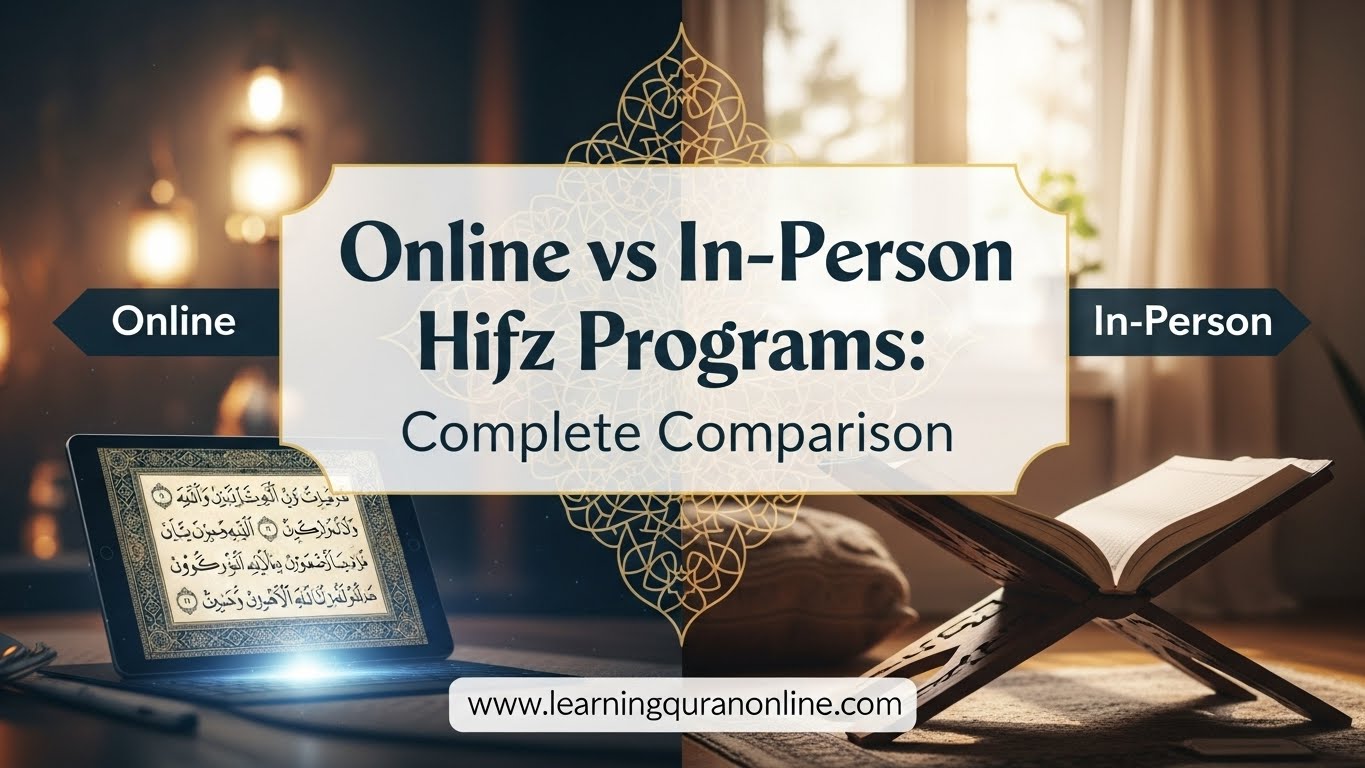
A Hifz program (Quran memorization course) is a structured curriculum designed to help students become a Hafiz — someone who has memorized the entire Qur’an. Hifz schools, institutes, or madrassas may offer residential (boarding) or day programs with varying emphasis on tajweed (proper pronunciation), revision schedules, sanad (chain of transmission), and integration with secular education. Recently, online Hifz classes and virtual memorization options have emerged, providing flexible alternatives to traditional face-to-face instruction.
Key Factors to Compare
When evaluating online vs in-person Hifz programs, consider these essential criteria:
- Teaching method: live online tutors, recorded lessons, one-on-one sessions, group classes, or residential live instruction.
- Quality of instructors: tajweed expertise, sanad, experience with Hifz students, and ability to teach remotely.
- Curriculum and structure: memorization pace, revision plan, assessment frequency, and integration with general education.
- Student support: supervision, mentorship, emotional guidance, and classroom discipline.
- Technology and resources: digital Quran apps, virtual classrooms, audio recording tools, and dashboards for parents.
- Cost and logistics: tuition, boarding, travel, and additional fees.
- Social and spiritual environment: mosque-based activities, peer community, group recitation (halaqah), and daily adhan/prayer structure.
Advantages of Online Hifz Programs
Online Hifz courses have grown rapidly due to technology, offering a range of benefits, especially for families with unique scheduling, geographic, or budget constraints.
- Flexibility: Students can schedule lessons around school, work, or other commitments. Online Hifz is ideal for those needing part-time or remote memorization options.
- Access to specialized tutors: Geographic barriers are removed; students can study with qualified instructors, including native reciters and certified teachers from different countries.
- One-on-one personalization: Many online programs offer tailored memorization plans and individualized feedback, which can accelerate learning for motivated students.
- Cost savings: Often lower tuition and no boarding costs reduce financial burden. Families save on travel and accommodation expenses.
- Technology-enhanced learning: Digital tools (audio, video, recording, progress tracking) support revision and self-study. Recorded sessions let students replay lessons for reinforcement.
- Safety and convenience: For younger learners or those in remote areas, online Hifz reduces travel and exposure risks.
Advantages of In-Person Hifz Programs
Traditional, in-person Hifz programs remain the gold standard for many families. The immersive environment of a physical Hifz school or mosque offers distinct spiritual and pedagogical advantages.
- Structured environment: Fixed schedules, halaqahs, daily prayers, and supervised revision create discipline and consistent memorization habits.
- Peer learning and community: Group recitation, communal worship, and social interaction foster spiritual growth and accountability.
- Immediate teacher supervision: Teachers can correct tajweed, monitor retention, and manage class dynamics more effectively in person.
- Immersive religious atmosphere: Living at or attending a mosque-based Hifz program reinforces spiritual focus and reduces secular distractions.
- Holistic pastoral care: On-site staff provide emotional support, mentorship, and sometimes a full boarding experience that shapes character and discipline.
- Accreditation and recognized sanad: Established in-person institutes often provide recognized certificates and traditional chains of narration (ijazah) upon completion.
Challenges and Limitations
Online Hifz Challenges
- Less direct supervision: Teachers rely on the student’s honesty and self-discipline; maintaining consistent revision can be harder remotely.
- Technical issues: Internet connectivity, device quality, and time-zone differences can disrupt learning.
- Social development: Limited peer interaction may reduce opportunities for communal worship, social skill building, and group recitation.
- Tajweed correction: Nuanced pronunciation correction is possible but sometimes less effective than face-to-face feedback.
In-Person Hifz Challenges
- Cost and logistics: Boarding and travel increase expenses. Families may need to relocate or send children away from home.
- Rigidity: Fixed schedules and residential rules may not suit every family or learner, especially those pursuing parallel secular education.
- Quality variability: Not all in-person institutes provide personalized attention; large class sizes can limit one-on-one time with a teacher.
Measuring Learning Outcomes: Retention, Tajweed, and Sanad
The ultimate goals of any Hifz program are accurate memorization, retention over years, proper tajweed, and, where desired, a sanad or ijazah. How do online and in-person programs compare?
- Retention: Consistent revision schedules matter most. Whether online or in-person, programs that enforce daily muraja’ah (revision) produce better long-term retention.
- Tajweed: Direct vocal feedback and tajweed drills are slightly more effective in-person but high-quality online tutors can deliver comparably with careful monitoring and recordings.
- Sanad and ijazah: Traditional sanad is more commonly issued through established in-person institutes and recognized reciters, though some online programs now offer digital ijazah arrangements with qualified shuyukh.
Hybrid and Blended Learning: Best of Both Worlds
Many modern Hifz programs adopt a blended model, combining online tutoring with periodic in-person intensive sessions or local halaqahs. This hybrid approach leverages technology for flexibility while preserving face-to-face mentoring and community.
- Online daily lessons with monthly in-person assessments or retreats.
- Local mosque halaqahs for group recitation combined with remote one-on-one tajweed coaching.
- Recorded progress portfolios shared with onsite supervisors for accreditation and sanad verification.
Cost Comparison
Costs vary widely depending on region, staff qualifications, boarding, and facilities. Typical cost considerations:
- Online Hifz: Lower tuition in many cases, no boarding fees, occasional technology subscriptions, and possible travel for in-person assessments.
- In-Person Hifz: Higher fees if residential, plus meals, accommodation, uniforms, and potential relocation costs.
Evaluate total cost per year alongside quality indicators — a cheaper program that offers poor tajweed or no revision structure may be false economy.
Which Option Is Right for You? Questions to Ask
Use this checklist when evaluating Hifz institutes or online platforms:
- What is the teacher-to-student ratio? Are tutors certified in tajweed and Hifz teaching?
- Is there a clear, scheduled revision plan to ensure long-term retention?
- Does the program offer ijazah or sanad upon completion, and who issues it?
- How are assessments conducted — live recitations, recorded tests, or in-person exams?
- What technology and resources are provided (apps, recordings, progress dashboards)?
- How does the program support emotional and spiritual development (mentorship, halaqah, prayer routines)?
- What are the costs, refund policies, and contract terms?
- Are references or success stories available from former students and parents?
Tips for Parents and Students
- Prioritize consistent muraja’ah. Daily revision beats cram-style memorization.
- Record recitations and keep a progress log — this works well with online Hifz and helps teachers spot weaknesses.
- Combine approaches: supplement online lessons with local halaqahs or community mosque activities to build social and spiritual skills.
- Maintain clear communication with teachers about pace, goals, and any academic commitments.
- Look for programs that balance tajweed with memorization techniques like chunking, visual mapping, and audio repetition.
Conclusion: Personalized Choice Matters
There is no one-size-fits-all answer to online vs in-person Hifz programs. Each has unique advantages: online Hifz offers flexibility, access to global tutors, and lower costs; in-person programs deliver immersive spiritual environments, peer accountability, and immediate teacher supervision. For many families, a blended model provides the most practical and effective route — combining the flexibility of digital learning with the discipline of face-to-face mentorship.
When choosing a Hifz program, evaluate the curriculum, teacher qualifications, revision plan, social environment, costs, and long-term learning outcomes. Prioritize sustained revision, strong tajweed instruction, and a support system that fosters both spiritual growth and academic balance. With the right program, students can achieve the noble goal of becoming a Hafiz while developing a lifelong relationship with the Qur’an.