Table of Contents
ToggleWhat Is the Memory Palace (Method of Loci)?
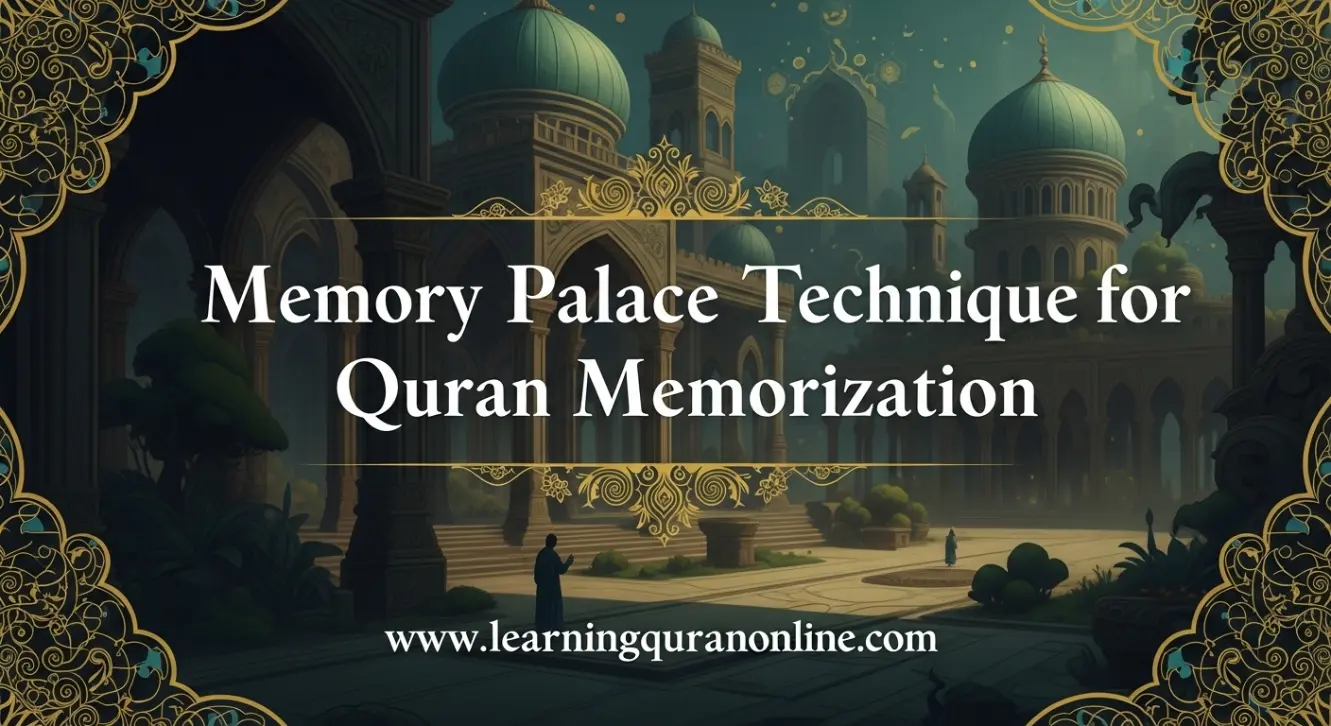
The Memory Palace is a mnemonic technique that uses spatial visualization to store and retrieve information. Originating in ancient Greece and Rome, the method of loci involves imagining a familiar place—your house, a mosque, a street—and placing mental “markers” or images (loci) along a path. Each locus represents a piece of information you want to remember. When you walk that path mentally, the images cue the associated content. For Quran memorization, these loci become anchors for verses, word groups, or key themes.
Learn Quran Online from the best online quran academy LQO
Why the Memory Palace Works for Quran Memorization
The Memory Palace leverages the brain’s strong spatial and visual memory systems. Compared to rote repetition alone, visual and spatial cues create richer associations that:
- Improve long-term retention and recall speed
- Facilitate chunking and linking of verses
- Reduce cognitive load during revision
- Enhance concentration and focus during Hifz sessions
Respectful Use: Maintaining Reverence and Accuracy
Always treat the Qur’an with reverence. The Memory Palace is a tool to aid memorization, not a replacement for traditional practices. Continue to recite with proper tajweed, seek a teacher or mentor to verify accuracy, and avoid visual associations that diminish the dignity of the text. Use symbolic, respectful imagery rather than irreverent or trivial pictures.
Step-by-Step: Building a Memory Palace for Quran Memorization
1. Choose a Familiar Palace
Select a well-known location you can visualize clearly—your childhood home, your local mosque, or a route you walk daily. The more vivid and stable the mental map, the better it will function as a mnemonic scaffold.
2. Define the Path and Loci
Create a logical route through the space. Pick distinct loci along the path—doorway, living room sofa, garden fountain, pulpit, etc. Each locus will hold a verse, a verse group, or a keyword cluster depending on the granularity of memorization.
3. Chunk the Quranic Text
Break the surah or hizb into manageable chunks. You can attach a single ayah to a locus, or attach phrases and word groups when verses are long. Chunking makes the material easier to encode and reduces memory overload during initial learning.
4. Create Respectful Visual Associations
Turn words, themes, or meanings into vivid, respectful images and “place” them at each locus. For example, for a verse about light (nur), imagine a gentle lantern on a table at the locus. For verses emphasizing mercy (rahmah), visualize a soft, welcoming doorway. Avoid literal or irreverent depictions of divine names—use symbolic, abstract representations instead.
5. Link with Recitation and Tajweed
Always pair the visualization with reciting the ayah aloud, focusing on correct tajweed and pronunciation. The auditory repetition anchors the visual memory and ensures the memorization is accurate for recitation.
Example: Applying the Memory Palace to a Short Surah
Suppose you want to memorize a short surah such as Al-Falaq or An-Nas. Choose a small palace with seven loci if the surah has seven verses. At locus one place an image representing the opening words, then continue placing images to represent key words or concepts in sequence. Recite each verse several times while “walking” the palace in your mind. Repeat this walk still aloud until recall is secure without the text.
Combining Memory Palace with Proven Hifz Strategies
The Memory Palace is most effective when integrated with other proven memorization techniques:
- Spaced repetition: Schedule reviews—daily, then weekly, then monthly—to transfer verses into long-term memory.
- Audio reinforcement: Listen to a skilled reciter and repeat to improve rhythm and tajweed.
- Teacher feedback: Regularly check your recitation and accuracy with a qualified teacher or mentor.
- Active recall: Test yourself by reciting the verses from memory and repairing errors immediately.
- Chunking and linking: Use the palace to store chunks, then link chunks together during revision to build longer sections.
Daily Memorization and Revision Schedule (Sample)
Creating a structured schedule makes Hifz consistent and manageable. Here’s a sample weekly plan integrating the Memory Palace:
- Day 1: New memorization—introduce 1–2 ayahs; place images in the palace and recite 15–30 times with tajweed.
- Day 2: Review yesterday’s ayahs (palace walk), add new ayah, and link to previous loci.
- Day 3: Intensive recitation (audio + teacher check), and mental palace walk without looking at text.
- Day 4: Consolidation—recite entire chunk from the palace path and correct errors.
- Day 5: Spaced repetition—review previous week’s sections using the same palace or additional palaces for larger sections.
- Day 6–7: Rest and light review—recitation in prayer times or evening sessions.
Advanced Tips: Scaling Your Memory Palace for Longer Sections
For longer memorization goals such as several juz or whole surahs, scale your strategy:
- Create multiple palaces (one for each surah or juz) or use larger palaces with many loci.
- Use hierarchical mapping—assign rooms to sections, furniture to paragraphs, and objects to specific ayahs.
- Color-code or theme palaces to help retrieval (e.g., green palace for Madinan surahs, blue palace for Meccan surahs).
- Use associative chaining—link the final image of one locus to the first image of the next to preserve flow.
Common Challenges and How to Overcome Them
1. Visualizations fade or become fuzzy
Remedy: Strengthen imagery by adding sensory details—sounds, textures, movement—or rehearse the palace daily for a few minutes to refresh the map.
2. Confusing similar loci and images
Remedy: Make loci distinct. Change colors, larger unique objects, or use specific smells/sounds mentally to differentiate areas.
3. Accuracy over speed
Remedy: Prioritize correct recitation (tajweed) with a teacher before speeding up recall. The Memory Palace should support correct memorization, not substitute for proofreading and correction.
Benefits Beyond Memorization
Using the Memory Palace for Quran memorization brings additional cognitive and spiritual benefits:
- Improved concentration and mindful focus during study
- Stronger long-term retention of surahs and ayahs
- Greater confidence during recitation and exams
- Enhanced spiritual connection—repeated, attentive engagement with meanings
Ethics, Dua, and Practical Considerations
Memorizing the Quran is an act of worship. Supplement your mnemonic practice with dua (supplication), consistent prayer, and sincere intention (niyyah). Make sure to handle the Qur’anic text respectfully: read from a physical mushaf when required, seek guidance from scholars on proper etiquette, and always verify memorization with qualified teachers.
Final Checklist: Starting Your Memory Palace for Hifz
- Choose a familiar palace and define a clear path.
- Chunk the text into manageable ayahs or phrases.
- Create respectful, vivid visual associations for each locus.
- Recite aloud with tajweed while mentally walking the palace.
- Use spaced repetition and teacher verification for accuracy.
- Scale with multiple palaces for longer sections and keep a revision log.
Conclusion
The Memory Palace technique is a powerful addition to traditional Quran memorization (Hifz) methods. When used respectfully and combined with tajweed practice, spaced repetition, audio reinforcement, and teacher feedback, the method of loci can significantly improve retention and recall. Start small, stay consistent, and let the mind palace become a respectful, spiritual waypoint on your journey to becoming a confident hafiz.